EAT ALL YOU CAN
The Florida Keys themselves were once alive. Their bedrock formed from the calcified remains of what was once a sprawling forest of coral, strangled of all color and complexity by the sudden onset of an Ice Age. Above this once-living stone is a slime congealed from centuries of rotting flora, just thick enough for each subsequent generation to take root, and atop this lies a hurricane-thin layer of tourist traps and human habitation.
Depending on who you ask, there are further Lost Keys of Florida, well beyond any exit from the Jimmy Buffett Memorial Highway. These isles border what Charles Fort called "the Super Sargasso Sea," and serve as a hidden sanctuary for unlicensed bush pilots, sovereign citizens, and the descendants of pirates.
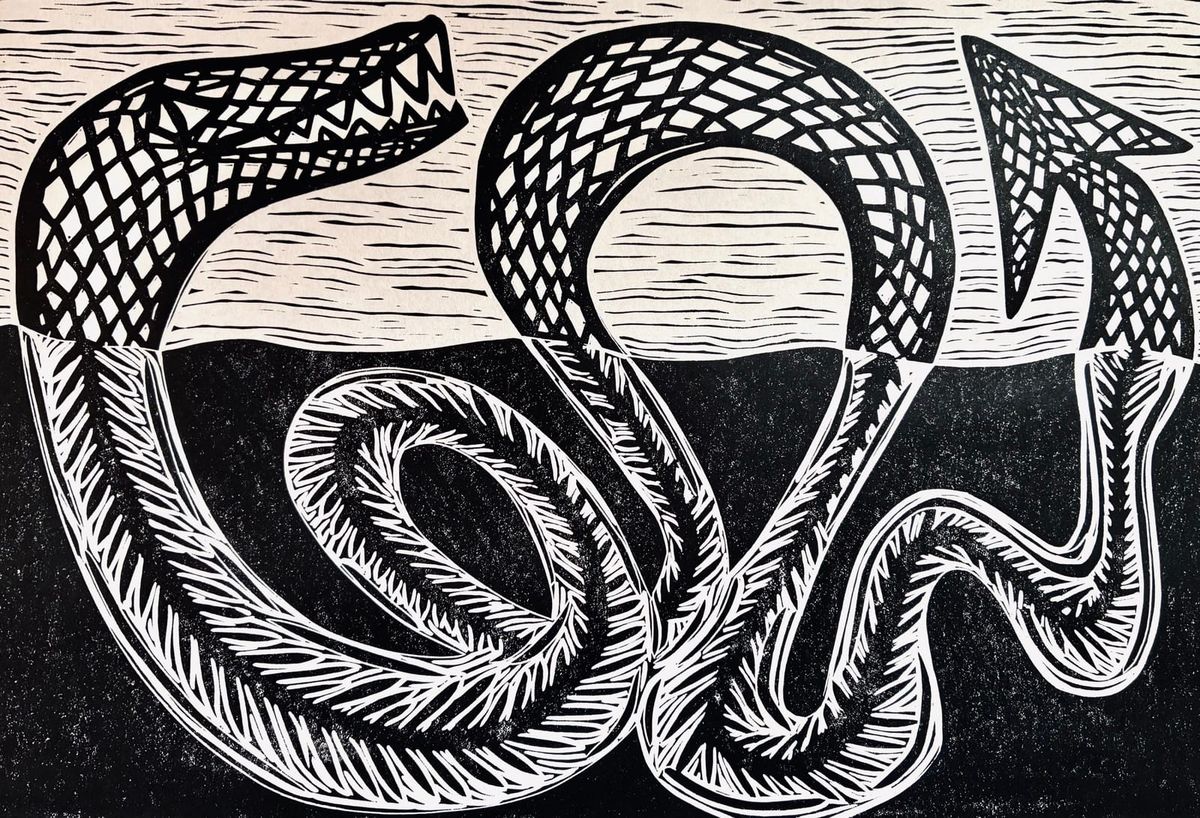
During my unexpected visit, I witnessed the field dressing and butchering of a sea serpent accidentally killed by a fishing vessel's outboard motor. Its thirty-foot long, shimmering body was hung by the tail from high hooks on the pier, falling apart in the afternoon sun. Colorful scales that could have been mistaken for macaw feathers at a distance wrapped its thick muzzle, and its dead eyes flickered with the signature sheen of tapetum lucidum. Its blood, clotted with ichthyotoxins too concentrated for human digestion, drained directly into the sea from a long slit in its belly. Local volunteers on ladders aggressively filleted meat from the carcass into long, spiraling curls as their well-worn electric knives hummed away.
These thin cutlets were lightly grilled with a rub of sea salt and white pepper, then glazed with eel sauce. A team of cooks served them in juicy heaps on crusty French bread slapped with a fermented key lime aioli, as well as handfuls of freshly julienned (land) cucumbers. The whole process was first come, first serve, eat all you can, as no matter how much of this sea monster they could manage to break down, the rest would be worms by nightfall.
Each piece of serpent melted on the tongue like a marbling of unagi and foie gras.
I learned from the locals that this fool’s dragon is truly a species of colossal eel, which has achieved a unique vertical anguilliform propulsion. Large nerve clusters segmented along its spine pulse with intense electromagnetic bursts to contract muscles in antipodal sequences, which form a standing wave that permeates the whole volume of the serpent's cylindrical frame. With half its body above the water while hunting, it confuses prey as to its size and position, who only see the submerged troughs of its sinusoidal motion. Sharks often fall for this trickery, believing these segments to be smaller fish, only to find themselves outfoxed by lateral bands of olfactory valves that can smell their angle of approach. This undulation pattern can be seen all throughout the serpent's anatomy; even its veins and intestines take on this self-similar waveform within.
“It’s why you’ll never find an eel with visible gonads,” my pilot explained. “Its DNA is only secondary in terms of embyro development, because that constant wiggling does most of the early work. As long as they’re close enough to other eels of the same frequency, especially the big ones, their collective ooze will coalesce into the right general shape from the electromagnetic field effect alone. That’s why they all gather in the sargasso, even if they have to digest most of their own skeleton during the migration to get there. The more complicated chemistry only happens once there’s a critical concentration of shed cells polarized in the water. Given that, they’re immortal, by most definitions.” He chuckled. “Nothing really dies out here. We might end up eating that very same sea serpent again in a few years.”